Anyone can install fibre. The question is whether it works, and whether you can prove it works. That proof comes from testing, and there are more tests than most people realise, each answering a different question.
Here’s what the main ones actually tell you.
OTDR: the map
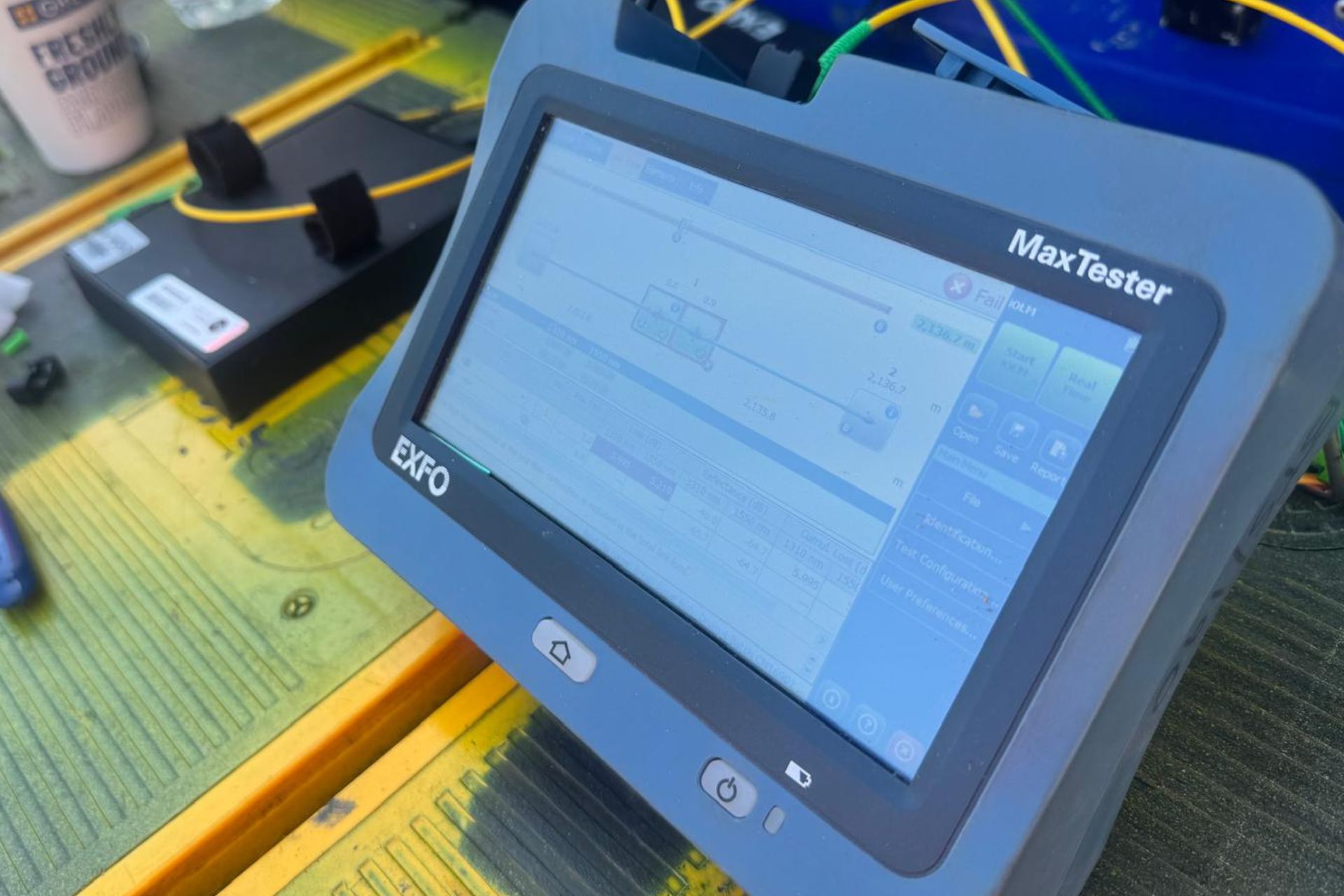
An OTDR sends a pulse of light down the fibre and measures what comes back. The result is a trace, a picture of the whole length of the link with every splice, connector and bend marked on it.
If something is wrong, the trace tells you where. Not “somewhere in that 2km run”, but a distance. That’s the difference between a half-day of digging and a targeted dig.
Insertion loss: the budget
Every component in a link costs you light. Splices, connectors, the fibre itself. Insertion loss testing measures the total, end to end, and compares it against what the design allows.
A link can pass an OTDR trace and still fail here, because the trace shows you events and this shows you the sum of them. Both matter.
Optical return loss: what comes back
Some of the light reflects back towards the source. Too much of it and the transmitting equipment starts misbehaving, which shows up as errors rather than an outright failure.
This is usually about connector quality. A dirty or badly mated connector is the most common cause, and the most easily fixed.
Chromatic dispersion: light spreading out
Different wavelengths travel at slightly different speeds. Over a long link that smears the pulses, and at some point the receiver can no longer tell one from the next.
It only matters on long distance, high-speed links. On a short run it’s irrelevant. On a 100km backbone at high data rates it’s the thing that decides whether the link works at all.
Polarisation mode dispersion: the awkward one
Light travels in two polarisation states, and tiny imperfections in the glass mean they arrive at slightly different times. Unlike chromatic dispersion, this changes with temperature and movement, so it’s not a fixed number you can design around.
Again, long-haul and high-speed only. But when it bites, it’s difficult to diagnose without the right kit.
Core-to-core crosstalk: multi-core only
Multi-core fibre puts several cores in one cladding. Light in one core can leak into its neighbour, and that leakage is the limiting factor for how much data you can push.
It needs a different kind of test entirely, measuring not just how much crosstalk there is but where along the fibre it occurs. We now test this on four cores simultaneously from one end of the fibre.
What the results are actually for
Test results are a baseline. Six months later, when something degrades, you compare the new trace against the one from handover and the difference tells you what changed.
Without that baseline you’re guessing. With it, fault-finding becomes a comparison rather than an investigation.
Not every link needs every test
A short run inside a building doesn’t need dispersion testing. A 100km backbone does. Part of the job is knowing which tests the link actually needs, and not charging for the ones it doesn’t.
Talk to us
If you need fibre tested, certified, or fault-found, we have the kit and the accreditation. Get in touch.